New Advanced Eye Surgery Program Already Treating Patients
Published Tuesday, August 4, 2026
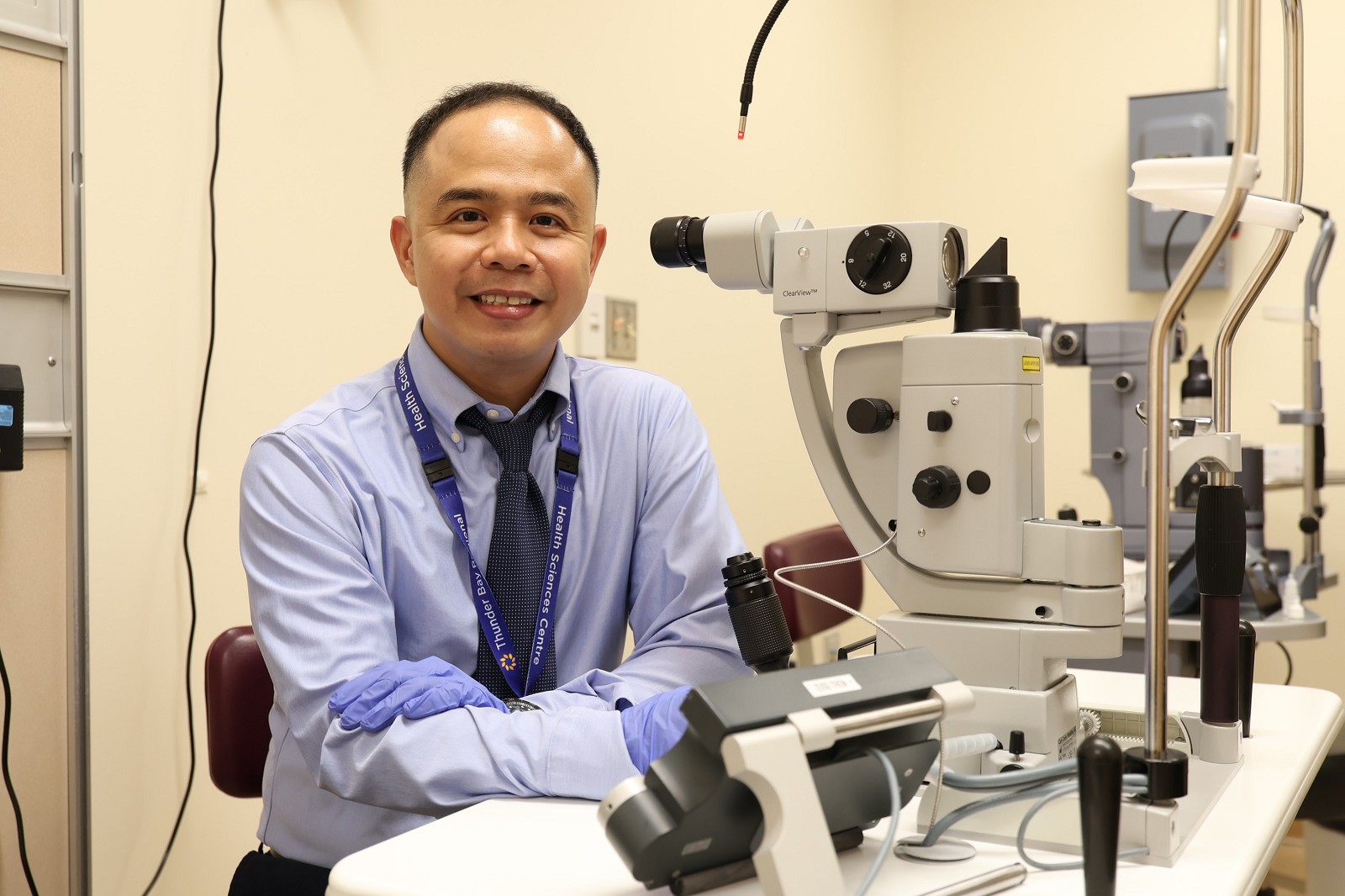
Vitreoretinal surgeon Dr. Alex Pisig joined Thunder Bay Regional Health Sciences Centre last summer and is working to expand advanced eye surgery in Northwestern Ontario. Donor support will help purchase a specialized Ophthalmic Ultrasound System for the Lions Vision Care Centre at the Hospital.
Your Help Needed to Purchase Specialized Ophthalmic Ultrasound
Almost all patients in Thunder Bay and Northwestern Ontario are forced to travel to Winnipeg and elsewhere for advanced eye surgery. Retinal detachment is a particularly serious condition because patients need to have surgery within days or risk permanent vision loss. As you'll read below, patients have to drive to get it – at least eight hours each way.
But change is coming…
Dr. Alex Pisig is working with the Hospital to enhance the eye surgery program at the Lions Vision Care Centre at Thunder Bay Regional Health Sciences Centre so more patients can be treated closer to home. The respected vitreoretinal surgeon joined the Hospital last summer because he saw a need in our region.
“This is my passion,” Dr. Pisig said. “I want to help people here so they don't have to travel to Winnipeg or elsewhere – especially in winter.”
As anyone who has driven in Northwestern Ontario can tell you, those roads can be dangerous. Last winter, Dr. Pisig sent many patients to Winnipeg including at least two during a snowstorm. One of those patients faced another snowstorm driving to a follow-up appointment.
“It made me feel bad. But ultimately, it was the only way to save their eyesight,” Dr. Pisig said. “That's why it's important to me to build a new local program, so people don't have to drive for care.”
Right now, about 20 patients per month have to leave the region for retinal detachment repair and other emergency vitreoretinal eye surgery – most at a moment's notice. The vast majority go to Winnipeg because it's the shortest drive, though some choose to go to Southern Ontario instead.
What is Retinal Detachment? And Why Can't Patients Fly?
The retina is a thin layer of light-sensitive tissue lining the wall of the eyeball. It turns light into the nerve signals that allow us to see. Sometimes though, the retina can tear like wallpaper. That tear can grow until a large part of the retina detaches.
That's when things get really serious.
Dr. Pisig can treat simple retinal detachment in some patients using a special gas – funded by your support of the Health Sciences Foundation. Dr. Pisig freezes the eyeball and injects a gas bubble to help push the retina back onto the wall of the eyeball – also like fixing wallpaper. Then, he lasers the retina to “tack it up” in several places. More laser treatments over the following weeks help keep the retina in place as it heals. Patients can't fly because pressure change affects the gas bubble, much like take-off and landing can affect your ears.
Bob Campbell was the first patient to receive this treatment in Thunder Bay in November 2025. However, the majority of patients still need to travel for care.
Dr. Pisig and Hospital administration are currently working together on a plan to convert one of the operating rooms at the Hospital into a dedicated vitreoretinal surgery suite. It starts with an Ophthalmic Ultrasound System. This specialized ultrasound system for the eye helps diagnose retinal detachment and other complex conditions, particularly when the ophthalmologist cannot see into the eye due to disease or injury.
“This new ultrasound is a very important diagnostic tool,” Dr. Pisig said. “It will lay the foundation for diagnosing and treating retinal diseases and trauma locally. We'll need equipment as we build the program – and this is the first step.”
We need $113,000 to bring the new Ophthalmic Ultrasound System to Thunder Bay, so please give what you can! With your donation today, you'll help Dr. Pisig treat more patients like Bob Campbell right here, closer to home! Donate online at: healthsciencesfoundation.ca/vision
Article by Graham Strong