“The Options Are None.”
Published Monday, August 10, 2026
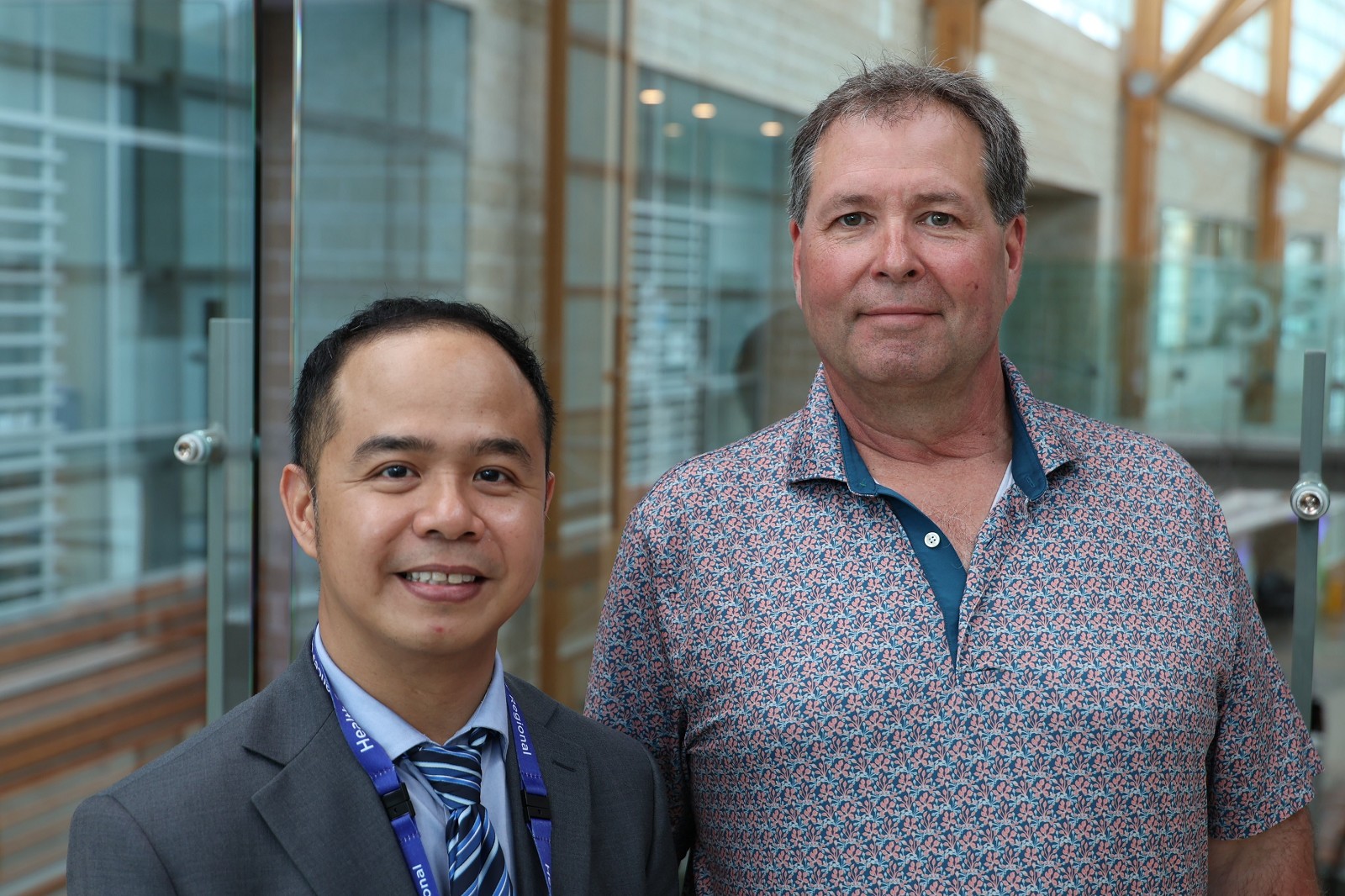
L-R: Dr. Alex Pisig, Vitreoretinal Surgeon with the Health Sciences Centre Lion's Vision Care Centre Team with Bob Campbell, the first patient to receive retinal detachment treatment in Thunder Bay using donor-funded specialized surgical gas. Bob's story highlights why advanced retinal care needs to be available close to home.
Thunder Bay's First Retinal Detachment Patient Talks about Why We Need Advanced Eye Surgery Here Right Now
Bob Campbell was shopping with his wife Sandra when what appeared to be a dark grey curtain covered the lower left part of his right eye. Most of us would be terrified that our vision was slumping away, but Bob took it in stride.
He didn't understand though that he was about to lose his vision in that eye.
“It looked fake like AI-generated smoke – a little unreal. But it was definitely fogging my vision,” Bob said. For weeks before, he'd had other symptoms like floaties that never went away. “I wasn't too concerned. But this was the first point when I thought, well, maybe I should get it checked out.”
He described the symptoms to his optometrist over the phone, and she told him to go to Emerge immediately. After a series of tests, Bob got the diagnosis: retinal detachment.
Retinal detachment is a serious condition that needs immediate attention. But Bob was lucky. He was about to become the first person to be treated right here in Thunder Bay with a special gas funded by your donations to the Health Sciences Foundation.
Bob met with Dr. Alex Pisig at 3pm that same day, and by 7pm the procedure was done and he was on his way home. It was a long day for Bob and Sandra, but he found out later that it could have been much worse.
“Without Dr. Pisig and those first gas canisters the Foundation funded two weeks earlier, I would have had to drive to Winnipeg and back,” Bob said.
It was November 2025, and snow could come at any time. Bob knew firsthand from his work in the oil industry how dangerous those roads could be in winter. It made him realize how lucky he was to be treated here – and how difficult it is for so many other patients forced to travel for care. In most cases, patients have to leave at a moment's notice, regardless of weather.
Today, Bob has fully recovered – Dr. Pisig saved his eyesight. However, most patients still need to travel for care until we have the equipment needed to treat more patients here.
“The options are none,” Bob said. “When your retina detaches, you need to get surgery, and you need to get it fast. That's why we need these procedures here now.
“The riskiest part of any emergency procedure shouldn't be travelling for treatment,” he said.
The first step, Dr. Pisig said, is to purchase a specialized ophthalmic (eye) ultrasound that will help him see inside the eye to diagnose retinal detachment and other retinal disorders, then plan treatment. This minimally invasive tool is particularly useful when Dr. Pisig isn't able to see directly inside the eye due to disease or injury. The Foundation committed to raising the $113,000 needed to cover the costs of the Ophthalmic Ultrasound System.
Retinal detachment is much more common than you may think.
“We need to talk more about the symptoms of retinal detachment,” Bob said. “After my treatment, I was talking to a friend who realized he had some of the same symptoms. He was able to get laser surgery for a torn retina before it detached, saving him from what I went through – or worse.”
You can help bring more advanced eye surgery services to Thunder Bay! Your donation today will go towards the $113,000 needed to fund this specialized ophthalmic ultrasound system. Donate online at: healthsciencesfoundation.ca/vision
Article by Graham Strong