Four Ways This Amazing Ultrasound Technology Reduces IV Pokes and Improves Patient Care
Published Friday, December 5, 2025
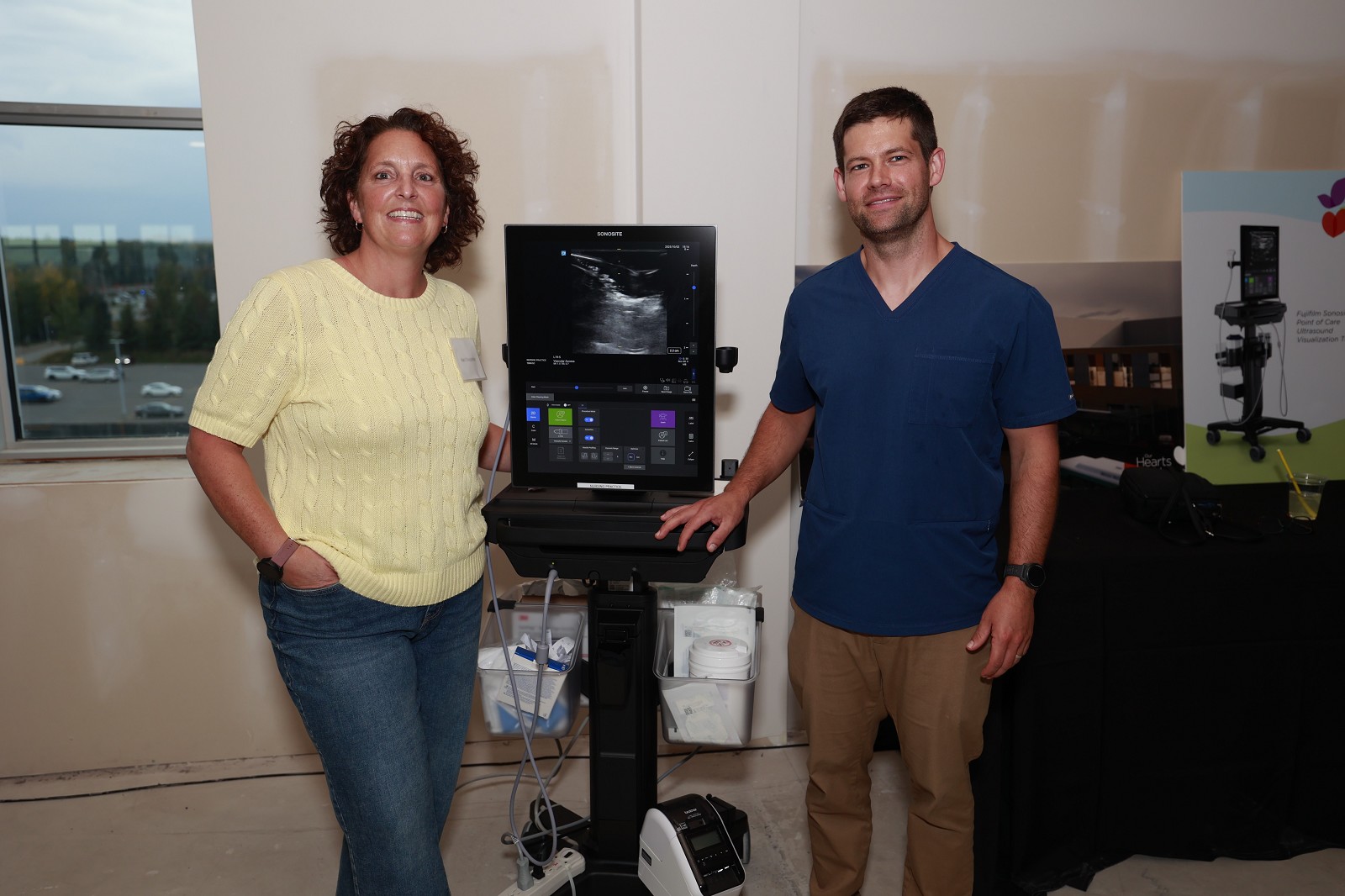
Kari Chiappetta, Foundation donor and former patient, with Vascular Access Clinical Nurse Specialist Justin Ross at the Chair's Reception in October. Kari advocated for the new VA ultrasound system after her own experience with hard-to-find veins, while Justin demonstrated the new technology for guests.
He's known as “The IV Guy” for the way he can find veins with one poke and less pain. He's been called a hero and an angel.
But, as Justin Ross is quick to tell you, patients can thank new vascular access (VA) ultrasound technology you helped purchase.
“Now, I can find the right vein and get the IV inserted with one poke almost every single time,” said Ross, Vascular Access Clinical Nurse Specialist at the Thunder Bay Regional Health Sciences Centre. “But with training, this new VA ultrasound system can make anyone look like a star.”
In other words, if you've donated to the Thunder Bay Regional Health Sciences Foundation, participated in a Foundation event, or bought a Thunder Bay 50/50 ticket, the real hero in this story is you.
In fact, the Hospital has many highly skilled nurses, but damaged and hard-to-find veins make it difficult for even the most experienced nurses to insert an IV.
The new technology revolutionizes IV insertions and improves patient care in at least four ways:
-
First, there is the image-guided system itself. The new system features crystal-clear, high-res images on a large monitor. The images are so clear that the size of the veins can be measured accurately and precisely with software. That helps ensure the vein is big enough to accept the gauge of needle needed.
-
The ultrasound can find deeper veins so far below the surface that they simply can't be seen otherwise. And even though they're deeper, they can still be reached with one poke.
-
The system can also assess the insertion and the health of the vein during the procedure or long after. For example, IV insertions usually only stay in the vein a certain amount of time – days or maybe weeks – because the vein naturally works the needle out over time. The ultrasound can see exactly where the needle tip is so the nurse can adjust for the longest lasting insertion. This also means fewer pokes.
-
The ability to find a vein almost anywhere in the forearm means that nurses don't need to insert IVs in less desirable locations.
The VA ultrasound is especially helpful for children, some of whom receive IVs on a regular basis. Damaged or hard-to-find veins makes IV insertion that much more difficult and often requires multiple pokes. Now, that's all changed.
“The ultrasound is a great tool for IV access in paediatric patients, especially for difficult IV starts,” said Brianna Jodouin, a paediatric nurse at the Hospital. “Being able to see larger and deeper veins diminishes the number of pokes children get. That improves patient outcomes and parent satisfaction, providing a better experience for all.”
“I wouldn't have been able to get this without support from the Foundation,” Ross said. “I want to say a big thanks on behalf of patients to all the Foundation donors and people who bought Thunder Bay 50/50 tickets. The ultrasound unit is literally life-changing for so many people, thanks to you.”
Big thanks to all the Foundation donors and people who bought Thunder Bay 50/50 tickets. The ultrasound unit is literally life-changing for so many people, thanks to you.
Article by Graham Strong