Your Impact: Third Echocardiogram Lab Reduces Wait Times for Heart Patients
Published Tuesday, February 17, 2026
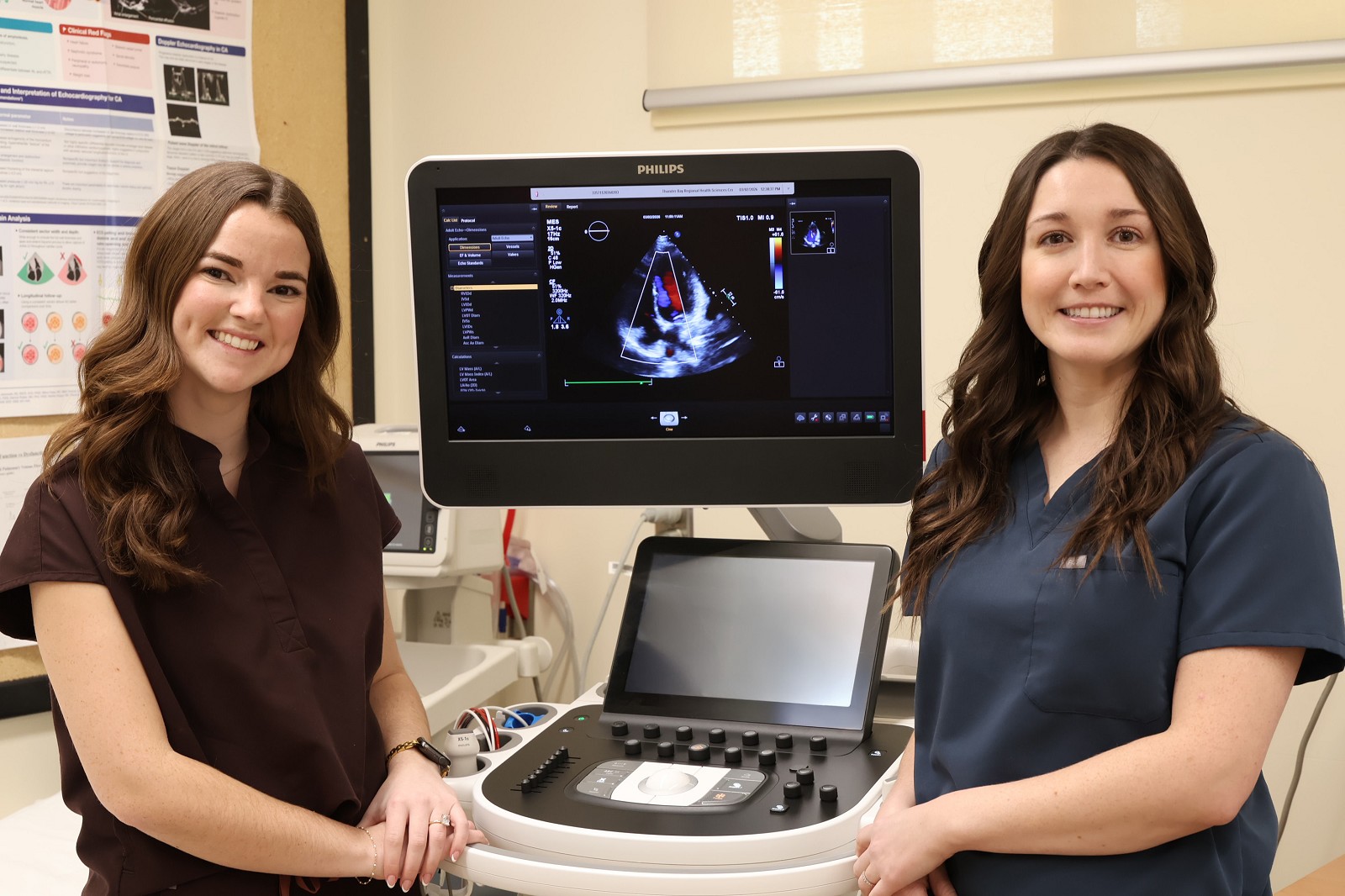
(L-R) Mikayla Sparks and Victoria Gerolami, Cardiac Sonographers at Thunder Bay Regional Health Sciences Centre, with the donor-funded echocardiogram that is helping reduce wait times for heart patients.
An echocardiogram is an essential, non-invasive tool for assessing and monitoring the heart. This device “sees” the size, structure, and function of the heart using ultrasound. It can be used in emergency situations, but it's also useful for routine monitoring and follow-up care for children and adults.
In fact, more and more echocardiograms are needed at the Thunder Bay Regional Health Sciences Centre every day. That's because more patients are able to get the care they need, right here at home. With the coming Cardiovascular Surgery (CVS) Program, that need will grow even more.
Now, thanks to your donations to the Thunder Bay Regional Health Sciences Foundation, your participation in Foundation events, and your purchase of Thunder Bay 50/50, the Cardiac Diagnostics team at the Hospital are better equipped to meet growing demand. You helped fund a third Echocardiogram lab, significantly increasing capacity for patients!
“Expanding capacity from two to three labs will allow us to perform more echocardiograms per day,” said Jill Kuzmich, Manager of Cardiac Diagnostics at the Hospital. “That means we can handle more scheduled exams as well as accommodate urgent requests more quickly. The third lab helps us reduce wait times for both inpatients and outpatients.”
The echocardiogram has many uses. It helps assess damage to the heart after a myocardial infarction (heart attack), assess and diagnose heart valve disease and damage, and monitor patients during certain treatments such as chemotherapy. It can also help Hospital staff look for infections, fluid, and inflammation around the heart. The echocardiogram is crucial for paediatric care as well, monitoring congenital heart conditions and treatments.
“We see paediatric patients every day,” Kuzmich said. “Childhood heart conditions, whether structural, functional, or rhythm‑related, often require ongoing monitoring. It's a child‑friendly tool that helps us make decisions about treatments including surgery and medication.”
It's child-friendly because echocardiogram is non-invasive or minimally invasive – a fast, easy tool with little or no discomfort for the patient. Like all ultrasounds, the echocardiogram uses sound waves, bouncing them off the structures of the heart. The “echoes” of those sound waves are mapped using computer software to create an image of the heart. Doctors and healthcare providers can see what's happening with the heart in real time including damage, abnormalities, and improvements after treatments.
Without this third echocardiogram lab, wait times would be longer for patients. “We would have to prioritize resources,” Kuzmich said.
In the most extreme situations, that could mean more patients travelling for care, delays in treatment planning, and longer hospital stays. For example, if a doctor orders an echocardiogram before discharge, the faster that patient can get their echocardiogram, the faster they can go home.
“As programs like the CVS Program expand, our diagnostic services must grow with them,” she said. “For example, a typical cardiac surgery patient requires three echocardiograms around the time of surgery, plus long‑term follow‑up. This expansion means we can maintain timely access for all patients.”
This is one of the many diagnostic imaging tools you've supported that make a real impact on patient lives every day! Find out more about how your support of the Health Sciences Foundation makes a difference at:
healthsciencesfoundation.ca/news
Article By: Graham Strong