Your Impact: Life-saving Equipment Improves Outcomes for Sickest Heart Patients, Thanks to You
Published Monday, February 9, 2026
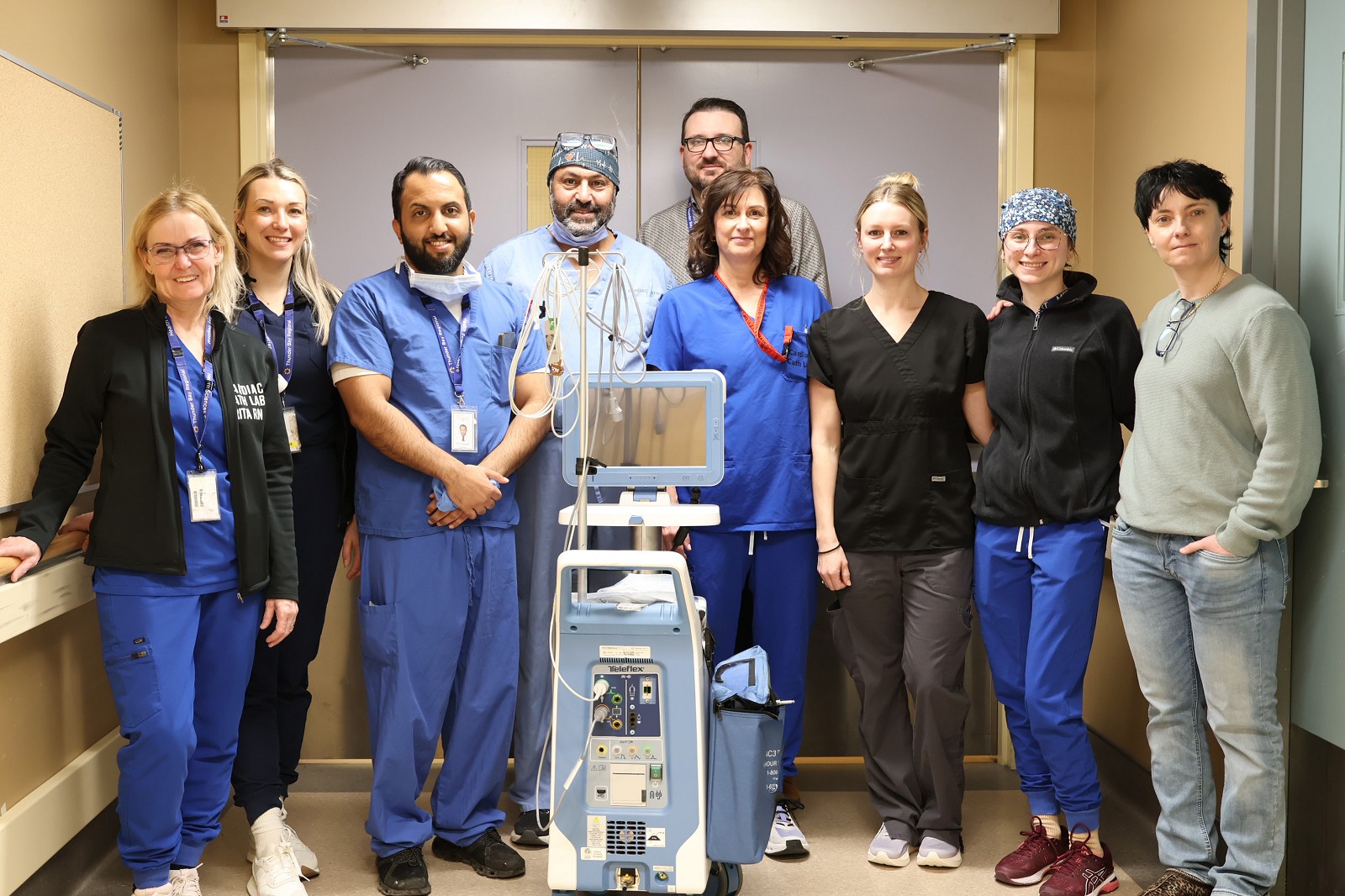
Members of the Cardiac Cath Lab team at the Thunder Bay Regional Health Sciences Centre stand with the intra-aortic balloon pump (IABP), a critical piece of life-saving equipment made possible through donor support.
Heart attacks and other serious cardiac events can seriously weaken the heart. In the worst cases, the heart may need life-saving intervention to help keep the blood pumping. When it gets that serious, doctors insert an intra-aortic balloon pump or IABP into the aorta, the main artery that carries blood from the heart to the rest of the body.
As the name suggests, an IABP helps the heart pump blood through the body when it's too weak to do it alone.
“Thankfully, we don't need to use this equipment very often,” said Matt Shonosky, Manager of the Cardiac Cath Lab. “But when we do need this kind of intervention, IABP is literally life-saving. Having this piece of equipment is essential for our cardiac program.”
Now, thanks to your donations to the Thunder Bay Regional Health Sciences Foundation, your participation in Foundation events, and your purchase of Thunder Bay 50/50 tickets, you've given a new IABP unit with the latest technology to the Cardiac Program.
Only the sickest cardiac patients at the Thunder Bay Regional Health Sciences Centre may need this level of intervention, and it might only be used a handful of times per year. But when patients need it, they really need it.
“We might not have any patients on IABP most days, but then we could have two or three patients needing support at the same time. It's so crucial, we can't have too many of these units at the Hospital,” Shonosky said.
For roughly half of the patients, IABP is a temporary measure to support the heart as it heals after heart failure, arrhythmia, or some other event that affects the heart's ability to pump blood. It takes some of the strain off the heart and allows it to heal or get back to normal function. Those patients can be treated right here in ICU. It's all controlled by a central workstation that monitors the heart and controls the pump.
“The unit itself helps doctors monitor the patient's heart constantly,” Shonosky said. “Initially, the IABP might pump with every heartbeat, but then they'll step it down to maybe every fourth heartbeat to see how the heart responds. Eventually doctors will wean the patient off the IABP completely, once the heart gets stronger.”
For the other half of patients, IABP helps pump blood and stabilize the patient while they are transferred to the Peter Munk Cardiac Centre at University Health Network (UHN) in Toronto for heart surgery.
“We need this equipment for the northwest,” Shonosky said. “Patients can't always be flown out right away due to weather or some other delay. The IABP vastly improves outcomes in those emergency situations. This is life-saving equipment that our patients need.”
In theory, the balloon pump can stay in the patient for up to 30 days. However, Shonosky said, doctors want to remove it as fast as possible once the patient's heart can pump on its own or the patient goes to surgery.
IABP will continue to be used before heart surgery, even when the coming CVS Program opens here, Shonosky said.
“Patients need to be in stable condition before they undergo any sort of heart surgery,” he said. “The IABP can help stabilize a patient's heart after an event, so they might spend a couple of hours in the ICU before the surgery itself.”
IABP is one example of the many life-changing – and life-saving – interventions that you help bring to the Hospital.
“Having donors support life-saving equipment like this – it's amazing,” Shonosky said. “I don't know if I have the words to say how thankful we are for their help ensuring we have this important intervention for residents in Northwestern Ontario when they need it.”
Find out more about the impact you have on local healthcare every day at:
healthsciencesfoundation.ca/news
Article By: Graham Strong