New Paeds Crash Cart for Sim Lab Provides More Realistic Training
Published Tuesday, December 9, 2025
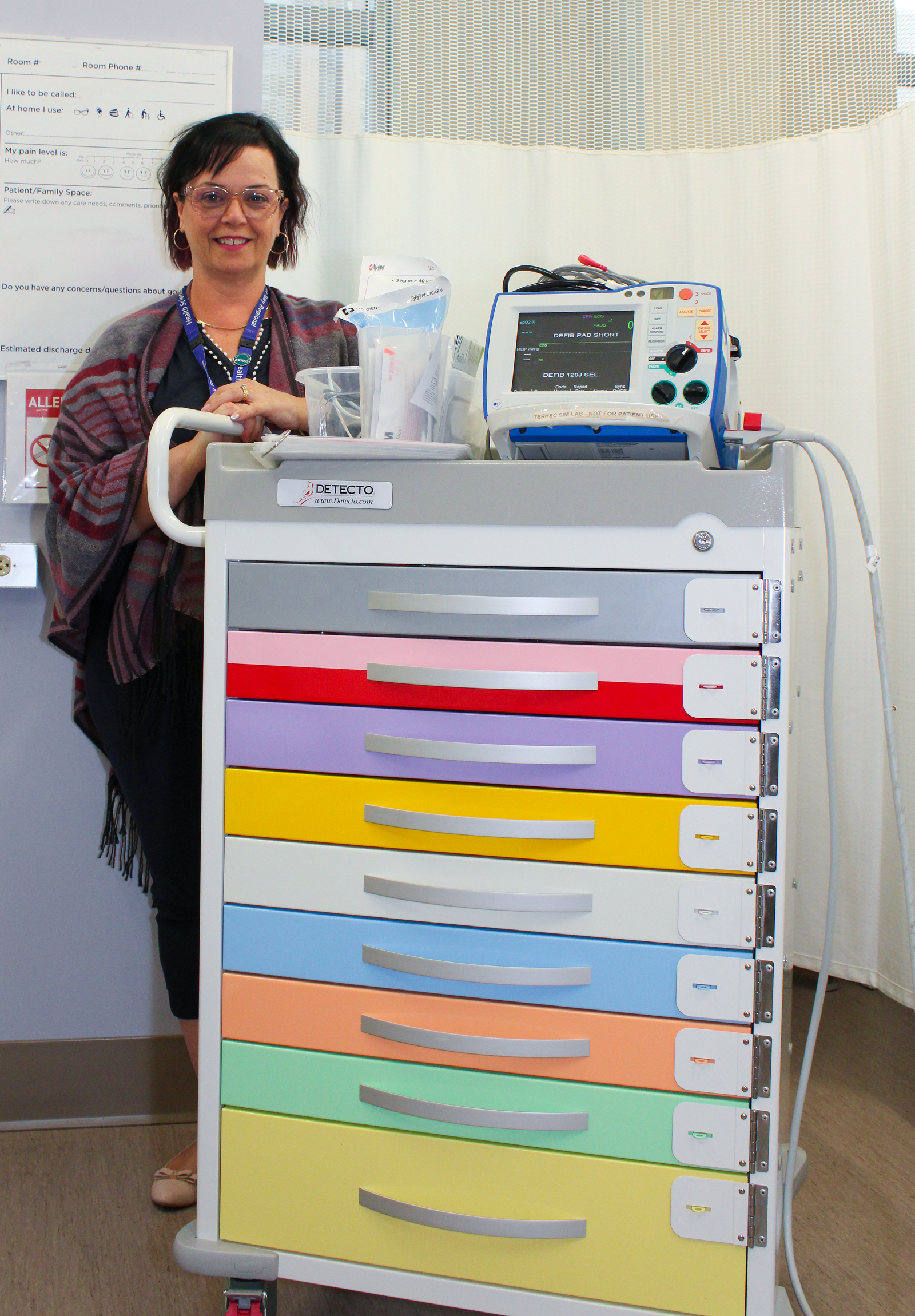
Leanne Baird, Simulation Program Manager at Thunder Bay Regional Health Sciences Centre, with the new paediatric crash cart that will provide more realistic emergency training in the Simulation Lab.
Paediatric emergencies often require different approaches than for adult patients. There's the obvious: smaller bodies mean lower doses of medications and specialized CPR methods. But things happen faster with children, making paediatric emergencies much more urgent.
“Children aren't simply small adults. Paediatric medicine is different than adult medicine,” said Leanne Baird, Simulation Program Manager at the Thunder Bay Regional Health Sciences Centre. Further, paediatric emergency procedures vary significantly between an infant and, say, a five-year-old. “Our simulation lab helps learners and our team practice different paediatric emergency scenarios so that they are better prepared when a real emergency happens.”
Until recently, learners had to practice using a crash cart designed for adults. But now, thanks to your donations to the Thunder Bay Regional Health Sciences Foundation, your support of Foundation events, and your Thunder Bay 50/50 tickets, the sim lab now has a paediatric crash cart that is just like the carts in use throughout the Hospital which provides for more realistic training.
All types of healthcare professionals use simulation labs – or sim labs – to train or practice. The Ibn Sina Simulation Lab at the Hospital provides a safe space for learners including students and residents as well as working nurses, physicians, and other healthcare professionals.
“We want simulations to be as real as possible,” Baird said. “Paediatric emergencies are high-stress situations, and much of what healthcare professionals learn becomes muscle memory. That means they can react faster and with more confidence in real-life situations.”
That practice and muscle memory leads to better patient care – and better outcomes. Muscle memory practice was one of the crucial parts of what was missing before.
“Before we had the paediatric crash cart, we laid equipment and medications on a table, but it didn't match reality in any way,” Baird said. “In emergencies, children are measured with a colour-coded tape that estimates weight, and crash carts have matching colour-coded drawers stocked with the right equipment. For example, if a child measures in the blue zone, everything needed is in the blue drawer. Training with an actual cart is far more effective.”
Learners can run through simulations as part of interprofessional teams or as a single-discipline group such as student nurses. In that situation, learners take turns as nurse and other healthcare professionals in the room. These learning situations also help students develop other crucial skills such as teamwork and communication.
Simulation learning is particularly useful for practicing scenarios that don't happen often. These are called high-acuity, low-occurrence events or HALO for short. For example, a paediatric cricothyrotomy to create an airway is rare. But when it happens, time is of the essence and the procedure is delicate. Learners can hone their skills so that when that type of emergency really happens in the Hospital, they know exactly what to do.
“It's that level of experiential practice that truly benefits the sim lab participant,” Baird said.
In some cases, sim learning keeps the healthcare professionals safe, too. For example, using a defibrillator does have a risk for being shocked. Practicing the proper techniques to ensure everyone is clear reduces that risk.
And it's all thanks to you! Every day, your support of the Health Sciences Foundation provides high-impact equipment for the Hospital. Find out more about how your donations and Thunder Bay 50/50 tickets make a difference at: healthsciencesfoundation.ca/news
Article By: Graham Strong