Portable Mannequins Help Nurses Practice Important Skills in Their Unit
Published Tuesday, December 9, 2025
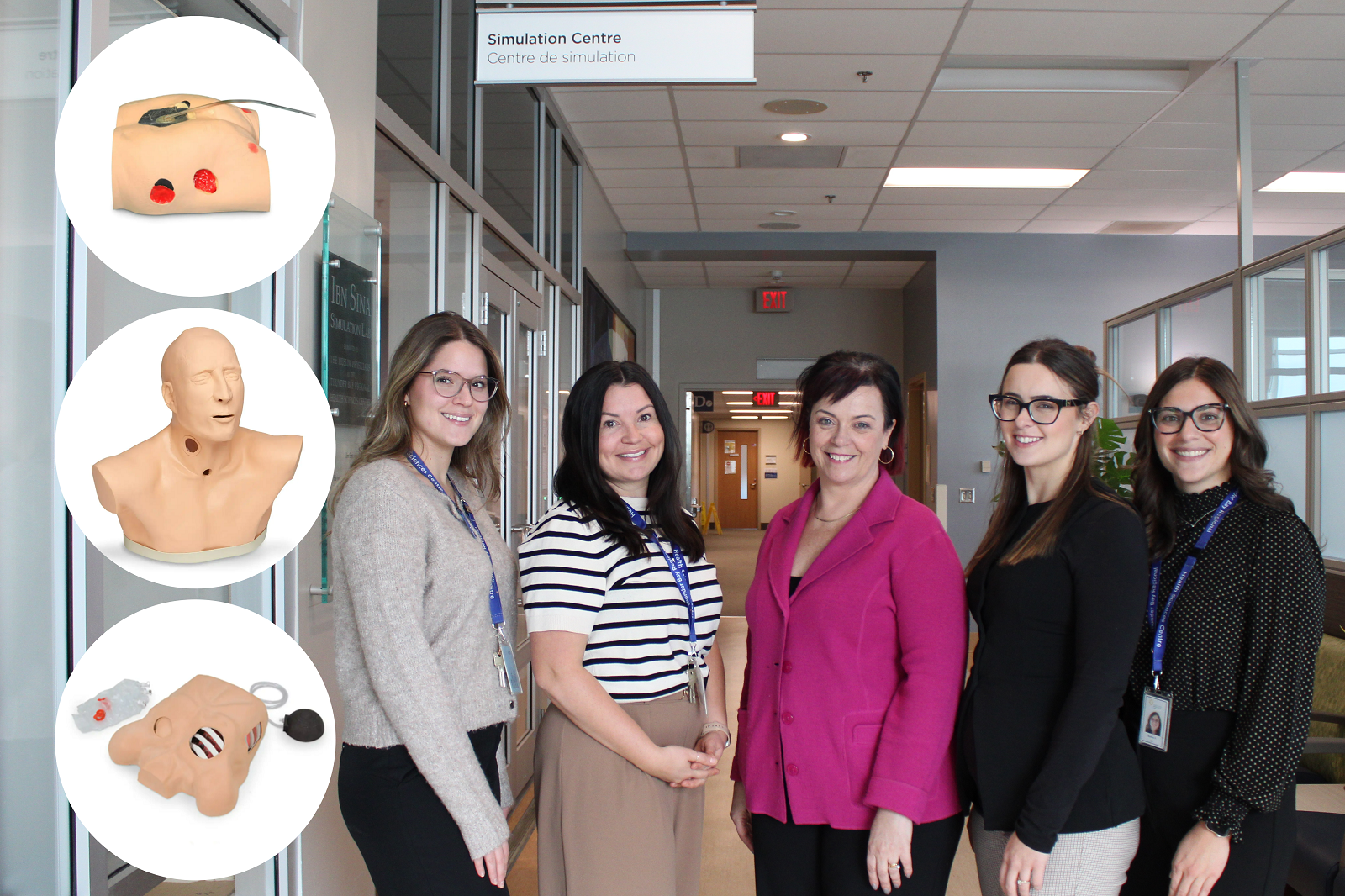
(L-R) MacKenzie Morancy, Clinical Nurse Specialist Medicine Programs, Katie Nelson, Clinical Nurse Specialist Surgical and Ambulatory Services, Leanne Baird, Simulation Program Manager, Emma MacKenzie, Clinical Nurse Specialist Trauma Critical Care and Neurosurgical, Kaitlyn Veneruz, Clinical Nurse Specialist Cardiovascular Surgery.
Nurses at the Thunder Bay Regional Health Sciences Centre are highly trained professionals who provide a wide range of care to patients every day. However, there are some procedures that they might not do regularly, but are vital when needed.
Clinical Nurse Specialists (CNSs) at the Thunder Bay Regional Health Sciences Centre often use simulation mannequins for training. These mannequins mimic real-life situations in a controlled environment, providing a safe way for nurses to learn and practice those skills.
Thanks to your donations to the Thunder Bay Regional Health Sciences Foundation, your participation in Foundation events, and your purchase of Thunder Bay 50/50 tickets, CNSs at the Hospital will have three new mannequins to provide training.
The Ibn Sina Simulation Lab has life-sized mannequins that are used for education and simulation training. However, these new mannequins are smaller and more portable for training outside the Sim Lab. They can be used during nursing orientation, in-the-moment education on the nursing units, and during R.E.F.S (“Roaming Education for Staff”), which is education that is provided to all Hospital staff with different monthly topics.
“The mannequins are convenient and easy to transport, making education accessible to our nurses,” said Katie Nelson, a Clinical Nurse Specialist at the Health Sciences Centre. She is part of the CNS team that provides ongoing education for nurses. “We're doing hands-on education all the time on various nursing units. These mannequins will help us provide that hands-on education.”
“We are able to teach nurses in their practice environment,” said MacKenzie Morancy, another CNS with the team. “We'll be able to go to the floor, provide education on updated procedures as needed, and review skills with them.”
Your support of the Foundation helped purchase three versatile mannequins that allow for a range of skills development. The wound care mannequin allows nurses to practice dressing a complex wound by using negative pressure wound therapy. With the tracheostomy tube sim mannequin, nurses practice suctioning secretions and cleaning the tube. The chest tube mannequin gives nurses the opportunity to practice tube care and maintenance.
“The mannequins are very helpful for procedures like these that are perhaps less common on the floors,” Morancy said. “Nurses are able to practice specific skills in a safe setting where we can simulate a situation and go over those processes with them.”
Right now, there are mannequins in the Ibn Sina Simulation Lab at the Hospital that nurses can train on as well. However, the two biggest advantages of the new mannequins are that they are portable and that they are specific to certain skills. Nurses call their CNS for assistance with skills, and these mannequins help them review.
“For these specific skills, it's easy for us to grab the mannequin, go to the floor, and practice with nurses right there on the unit,” Morancy said.
“We're so grateful for everyone who supported the Foundation so we could get these mannequins,” Nelson said.
Your support of the Health Sciences Foundation helps fund projects like this every day. Find out more ways you're helping improve patient care at the Hospital by visiting: healthsciencesfoundation.ca/news
Article By: Graham Strong