Your Impact: New Ultrasound Unit Makes Starting Dialysis Faster and Easier
Published Tuesday, September 29, 2026
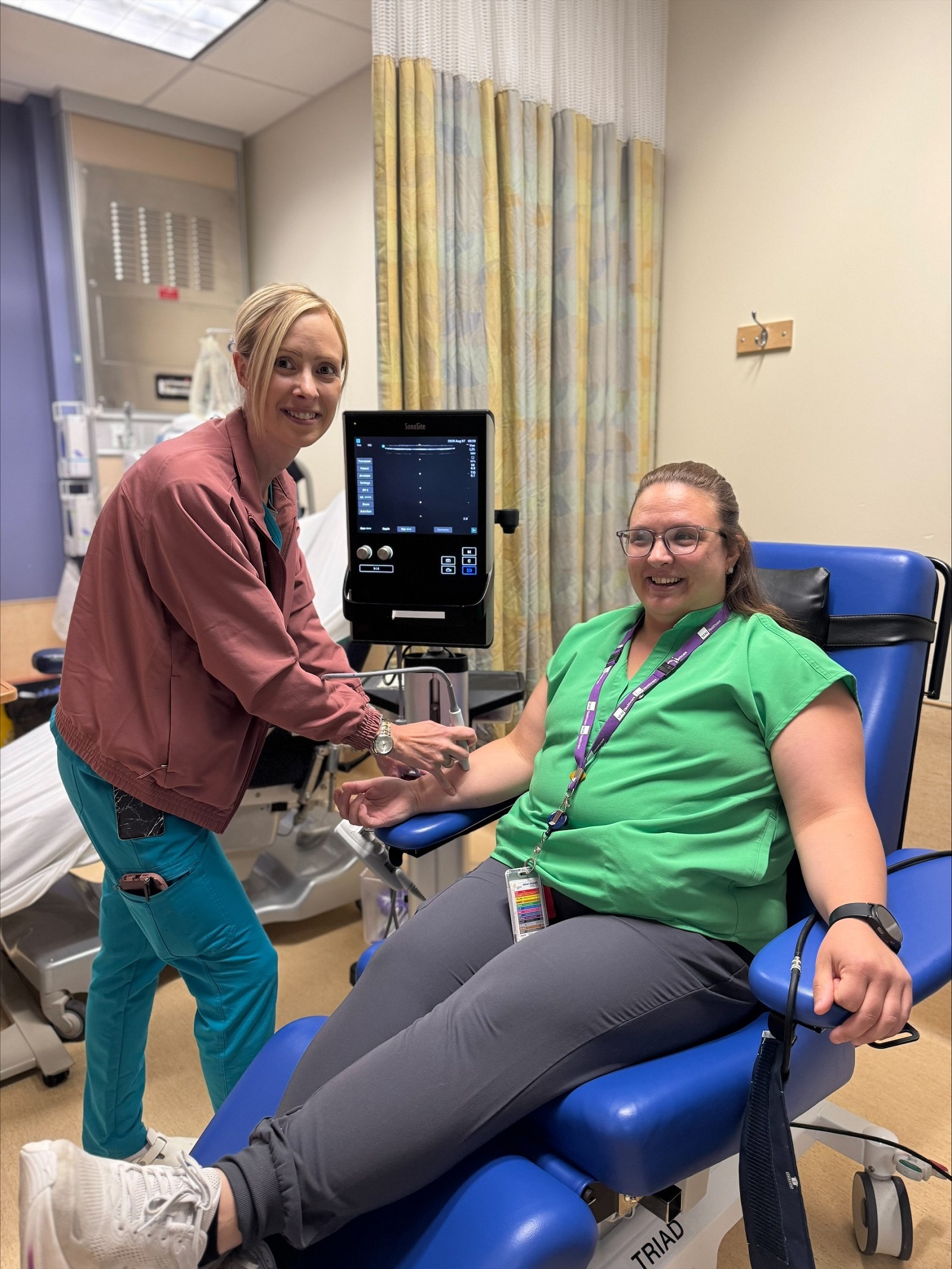
Tracy Oleschuk, Registered Nurse, and Brittany Hrabok, Dialysis Aide, with the new ultrasound unit supporting faster, easier dialysis needle insertion at Thunder Bay Regional Health Sciences Centre.
During dialysis, patients sit for three or four hours per treatment, three or four times per week as a dialysis machine cleans their blood. For people with fistulas – a fixed entry point in their veins created by a surgeon – it means at least two needle pokes every single time.
As you can imagine, regular needle insertions can be stressful and painful. What's worse is that veins can be damaged and scarred over time, making the procedure even more complicated – and more difficult to tolerate.
But you helped make the procedure easier for patients and staff thanks to your donations to the Thunder Bay Regional Health Sciences Foundation, your participation in Health Sciences Foundation events, and your purchase of Thunder Bay 50/50 tickets! Your generosity gave staff a new ultrasound unit that helps make dialysis needle insertion faster and easier for patients at the Thunder Bay Regional Health Sciences Centre.
Inserting dialysis needles takes training and expertise. Allyson Hoard-Mann, Manager of the North West Regional Renal Program, said that the nurses in the Hemodialysis Unit are among the best anywhere.
“In the old days of needle insertion, you'd look, you'd feel, you'd listen – and the nurses in the Hemodialysis Unit are really good at that,” Hoard-Mann said. “The ultrasound gives you that extra bit of reassurance, because you can see where the needle is and know exactly when it's in place.”
The ultrasound unit also helps nurses gain expertise, which is helpful in a busy unit like hemodialysis. The “look, feel, listen” insertion method is a skill developed over time. Using the ultrasound for needle guidance is a skill that requires training as well, but the advantage is that staff can visualize needle placement.
Ultrasound can also help nurses assess the fistula during treatments and re-assess needle placement if problems arise.
“That fistula is the patient's lifeline,” Hoard-Mann said. “If the fistula gets damaged or you can't use it for a length of time, we'll have to find another way to provide dialysis. Dialysis is a life-saving treatment that's not optional.”
The ultrasound can be used for other assessments. For example, a nurse practitioner in Renal Services can monitor fluid build-up in the body. This newest model of ultrasound provides nurses with more information than ever including colour contrast that provides a clearer view of processes like blood flow.
“The nurses are on the frontline for identifying issues with the fistulas – and this ultrasound helps them see problems faster,” Hoard-Mann said. “If they have a concern, they can call in Renal Services' Vascular Access Coordinator to have a look. Then, they can refer on to a nephrologist or a vascular surgeon as needed.”
Because the Hemodialysis Unit is such a busy place running 7am to 11pm, six days per week, it's important nurses have access to ultrasound units when they need them. Thanks to your help, each of the five pods in the Hemodialysis Unit now has its own dedicated machine.
“It's important to us that patients don't have to wait to get dialysis,” Hoard-Mann said. “Their treatments are long enough – we don't want to make them even longer because we don't have the right equipment on hand. Now that we have this fifth ultrasound unit, we can get patients started faster.”
Your generosity has a tremendous impact on patient care at our Hospital every single day!
Article by Graham Strong