“As Seen on TV” Ring Rescue in Thunder Bay Thanks to Family CARE Grant
Published Monday, May 25, 2026
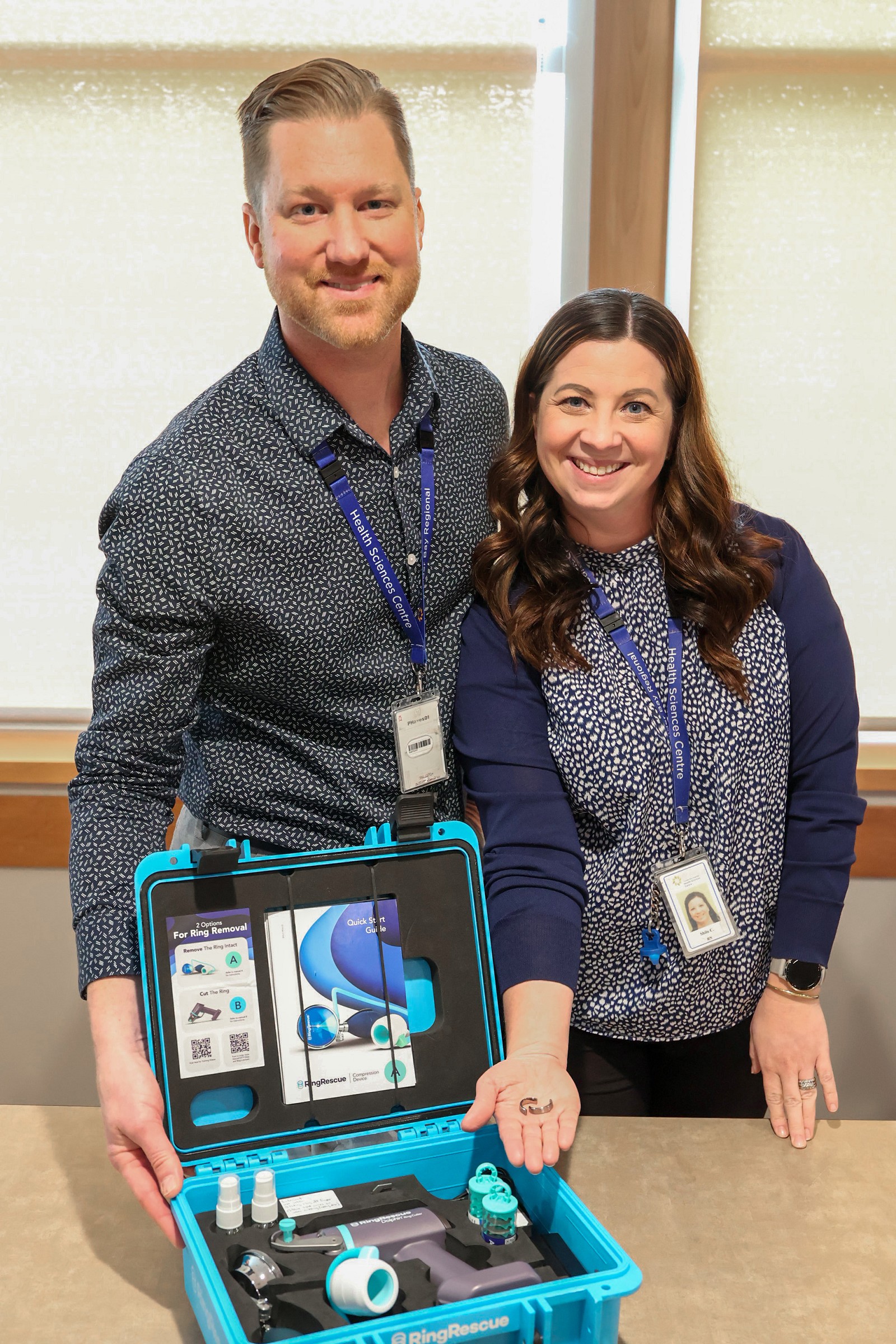
Peter Hayes, Clinical Nurse Specialist in Emergency and Trauma Services, and Shilo Chamut, RN, Emergency Care Services at the Health Sciences Centre showcase the new Ring Rescue device made possible through donor support of the Family CARE Grant Program.
Fans of the hyper-realistic show The Pitt may remember an episode last March when the emergency department team cut off the wedding ring of an injured man using a seemingly “magical” device.
In fact, both the situation and the device are real. It's a condition called ring entrapment, and it happens way more often than you may think.
Thanks to your support of the Family CARE Grant Program, the Emergency Department at the Thunder Bay Regional Health Sciences Centre has the new, Canadian-made Ring Rescue device that gives staff a revolutionary new tool to safely remove rings from fingers faster in emergency situations.
“We see ring entrapment in the Emergency Department a couple times per week on average,” said Peter Hayes, a Clinical Nurse Specialist in Emergency and Trauma Services in our Hospital. “It can happen for many reasons including swelling from an infection, an allergic reaction, increase in body mass index, arthritis, or an injury – a trauma to the digit.”
That was the situation on The Pitt. A man had to have surgery to his finger, but that meant removing his ring first. For severe injuries, it's often better to cut the ring than try to slide it off. In other situations, swelling can make it impossible to remove the ring. Swelling can actually get to the point where the ring cuts off circulation to the finger, leading to amputation in extreme situations.
Previously, staff would try compression techniques with lubrication to slide the ring off. If that didn't work, a surgeon might use a specialized cutting device in the operating room.
“We had a manual ring cutter that had a little guard and a cutting disc. You would turn a wing nut to slowly cut through the metal,” Hayes said. That took a long time, even with softer metals like gold and silver. “You could be grinding for 10 or 20 minutes or more.” Harder materials like titanium, stainless steel, and ceramic are impossible to cut off with the manual ring cutter and required other interventions.
But Ring Rescue has changed all that. The device, which is about the size of a hair dryer, is like a mini medical-grade grinder.
“For soft metals like gold, it only takes a couple of minutes to remove a ring,” he said. And, Hayes said, it will cut through anything. “For harder materials, it might take six minutes to cut through each side.”
It's also extremely safe. When the blade cuts through the ring and touches the finger guard, Ring Rescue automatically indicates that it's cut 100% through. “It's not high velocity, so it doesn't throw sparks or fragments. The cutting disc is also lubricated, which keeps the temperature down so that it doesn't burn the patient.”
The Ring Rescue Kit also features its own compression device which staff can try before cutting to save the ring.
Ring entrapment can be prevented in some cases. Hayes suggests removing rings as fast as possible if you experience swelling in your fingers. Visiting the Emergency Department sooner rather than later in extreme situations will help prevent long-term damage. He also suggested avoiding home compression remedies if the finger is injured.
“Those can actually lead to further tissue damage and increase the swelling, which will decrease the chances of us being able to compress the finger and salvage the ring,” Hayes said. “Coming to Emerge is always the best option.”
Family CARE (Care Advancement Recommended by Employees) Grants are like suggestion boxes for frontline staff. The biggest difference is that thanks to donors like you, staff can fund their suggestions and bring them to life for better patient care. Read about other great projects and make your donation at: healthsciencesfoundation.ca/familycare
Article by Graham Strong