Family CARE Grants Help Paramedics Train for Infant Emergencies
Published Tuesday, December 9, 2025
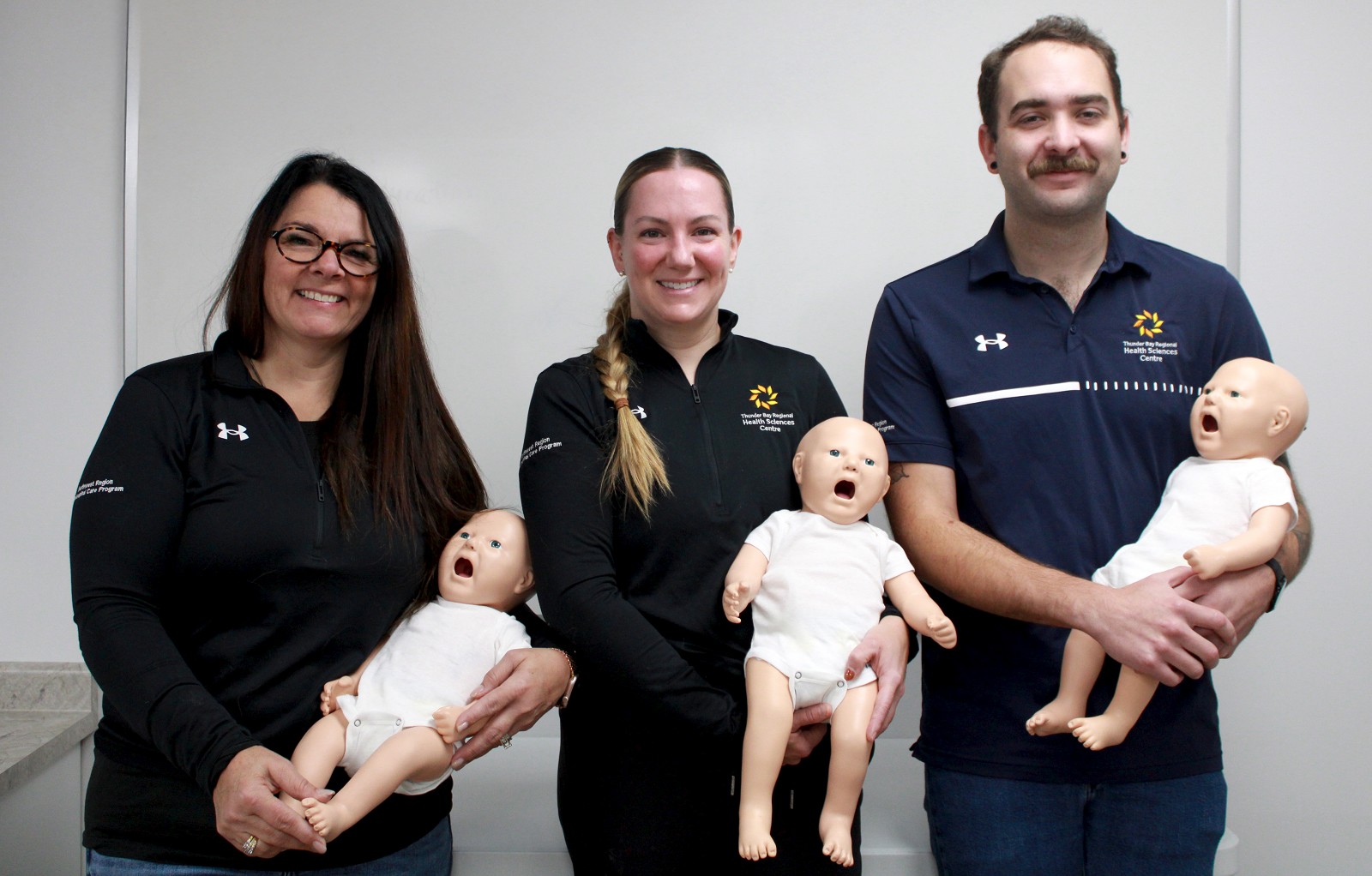
(L-R) Thunder Bay Regional Health Sciences Centre Clinical Educators Joslyn White, Jade Kmill, and Jacob Davies with three of the new simulation mannequins funded through the Family CARE Grant program.
For paramedics, transporting an infant in distress to hospital is about as intense as it gets. They rely upon all their skills to ensure the baby gets to the Emergency Department safely.
That's what makes simulation labs so important. Sim labs provide valuable training and practice for healthcare professionals including learners and those already working in their fields. Simulation is particularly useful for practicing high-acuity, low-occurrence events (HALO) events – potentially life-threatening emergencies that don't happen very often. Many infant emergencies fall under this category.
Now, thanks to your support of the Thunder Bay Regional Health Sciences Foundation's Family CARE Grant Program, the Northwest Region Prehospital Care Program (NWRPCP) has five new infant simulation mannequins for paramedics in the region to train and maintain their skills.
“Simulation is incredibly important for building skills and confidence, especially for HALO events. It's the basis of pretty much all clinical work,” said Paul Starkey, Operations Coordinator for NWRPCP. “The closer you can replicate patient scenarios, the better it is to train for those situations and maintain those skills.”
Starkey provides training, certification, and ongoing education including simulation sessions for Northwestern Ontario's EMS and Base Hospital programs. The training facility has a wide range of mannequins, but some were getting old and worn out. New upgraded mannequins provide paramedics with a more true-to-life experience during their training and practice.
For example, infant intubation is a very rare intervention. But when a baby is struggling to breathe, it's an incredibly dangerous situation for the infant – and stressful for the paramedic. An infant's small size adds to the difficulty, but it's their different proportions that require specific techniques.
“There are nuances in anatomy at that age – infants are not just tiny humans,” Starkey said. “The structure of their airways is different. They have larger tongues, larger heads compared to their bodies... Infant intubation requires a different approach.”
The infant mannequins give paramedics hands-on simulation to help them hone those skills so that they are ready when needed. The three mannequins you helped purchase are more realistic than ever before with a more detailed airway for better learning.
“Having these new mannequins makes the training experience more life-like. They're an invaluable learning and practice tool,” he said.
You also helped purchase two new infant birthing simulators to help paramedics train for times when mothers in labour won't make it to the hospital to deliver. It's uncommon but not extremely rare, Starkey said.
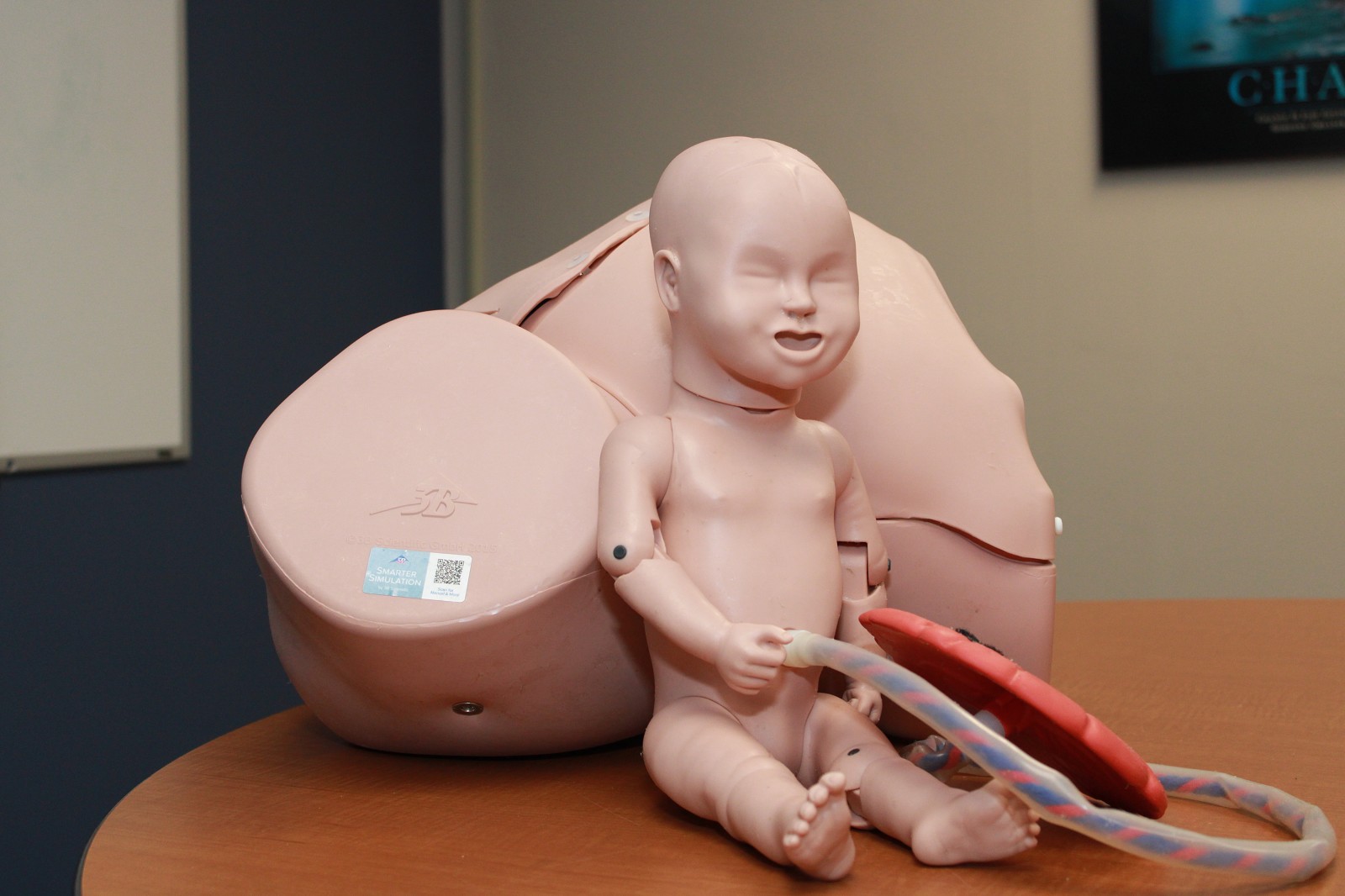
Two new birthing simulators will help paramedics prepare for deliveries that happen before reaching the hospital.
“We're able to give paramedics experience attending an uncomplicated childbirth, but we can also run scenarios with varying degrees of complications such as breech birth or a post-partum haemorrhage. Paramedics can learn how to take care of a newborn during those first minutes of life as well, such as cord management and managing complications.”
Although paramedic students train for childbirth, ongoing training is invaluable for those HALO situations. Several years ago, Ontario EMS partnered with midwives to improve prehospital care training for paramedics. That partnership and these new simulators ensure paramedics are better prepared and more confident during out-of-hospital births.
“I can't speak highly enough of the midwife group we worked with,” Starkey said. “They were professional through and through, and they helped our paramedics take their skills to the next level.”
This invaluable training wouldn't be possible without your donations to the Health Sciences Foundation. The Family CARE Grant program takes ideas from front-line staff to improve patient care and funds them thanks to your donations. Find out about other Family CARE Grant projects you've helped bring to life at: healthsciencesfoundation.ca/familycare
Article By: Graham Strong